

Seminar ZAND: Agata Stanisz
13.10.2026
Troubles with Relationality: Methodological Experiments Around More-Than-Human Infrastructure.
This lecture attempts to systematize several methodological and procedural issues that have emerged during my research on transport, water supply, and sewage infrastructure. The starting point is a relational understanding of infrastructure—developed within the anthropology of things, materiality studies, and the “infrastructural turn”—which posits that infrastructures cannot easily be reduced to material objects with clearly defined boundaries. Roads and water or sewage networks function through relationships with other systems, materials, organisms, and environmental processes; my research (both fieldwork and beyond) has begun to reveal sites where these initially distinct realms overlap, intersect, and mutually transform one another.
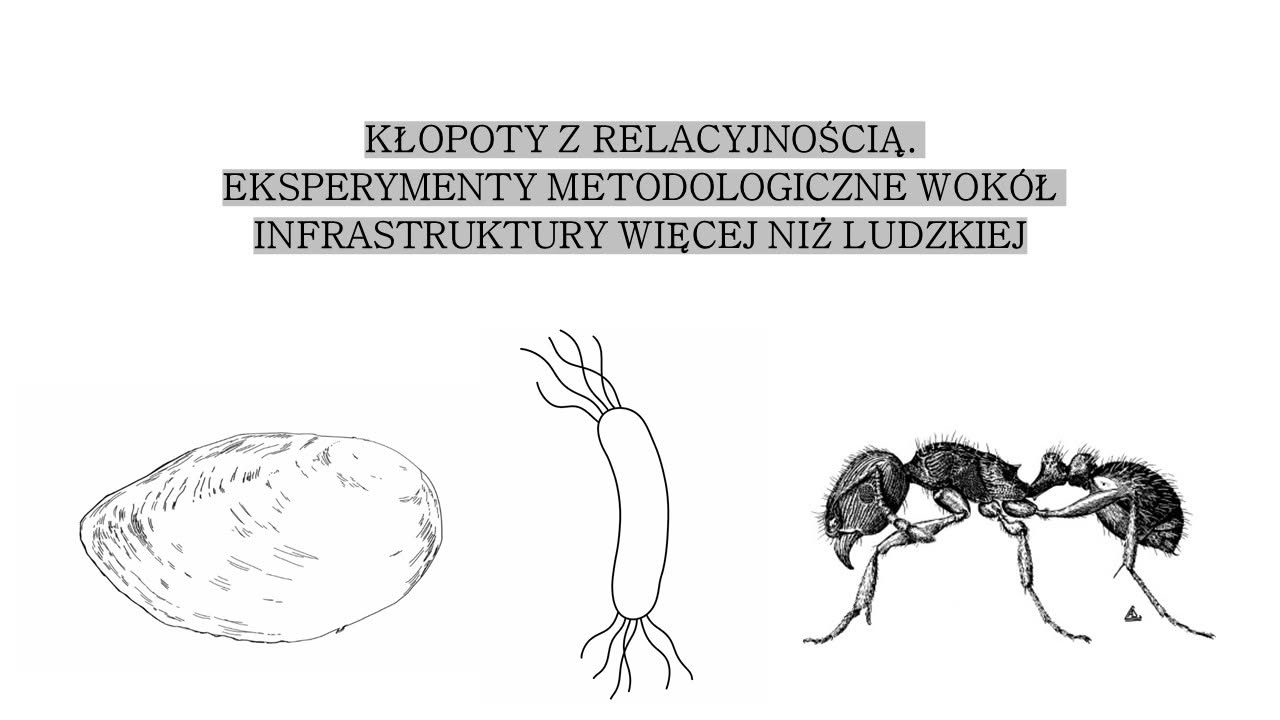
I treat relationality as a category requiring empirical experience and verification. If infrastructure is relational, the question remains: which relationships matter for its operation? How can they be identified, and where should the boundaries of analysis be drawn so that relationality does not devolve into the generic claim that everything is connected to everything else? This issue becomes particularly acute when infrastructural research incorporates more-than-human perspectives. Swan mussels and luminescent bacteria participate in water quality biomonitoring; activated sludge microorganisms perform the bulk of biological wastewater treatment; water properties influence the design and operation of technical systems; and byproducts of processes occurring within the sewer system are released into the air, where they are further affected by temperature, pressure, humidity, and wind. In studies of transport (especially waterborne transport), similar questions arise when infrastructures designed for moving people and goods are also analyzed as conditions for the mobility of organisms and ecological processes.
However, expanding the scope of anthropological attention in this way turns out to generate fundamental epistemological difficulties. I no longer assume that more-than-human anthropology grants access to the perspectives of other organisms, matter, or physical phenomena. While a mussel’s reaction can certainly be observed and recorded, bacterial metabolism described through biological knowledge, and water movement or the dispersal of substances in the air reconstructed via measurements and expert knowledge, none of these practices entails adopting a non-human point of view. Any attempt to speak on behalf of other entities remains entangled in human language, scientific practices, institutional rules of knowledge production, and the politics of representation.
I am therefore less interested in the possibility of achieving a more-than-human perspective than in what the attempt at de-anthropocentrization does to the anthropological toolkit. Infrastructure studies prove particularly demanding in this regard. Access to many of its elements is restricted; some of the processes I study occur beyond the scale of direct perception; and knowledge about them is generated through measuring devices, biological indicators, documentation, experts from other disciplines, sensory experiences, and the traces and effects of the systems’ operations. I will therefore treat this lecture as a presentation of several research attempts, workarounds, and failures that allow us to question both the utility of a relational and more-than-human anthropology of infrastructure and the limits of knowledge that these approaches reveal rather than eliminate.
Agata Stanisz – Social anthropologist and ethnographer; professor at Adam Mickiewicz University in Poznań, affiliated with the Institute of Anthropology and Ethnology. Her research interests encompass the anthropology of infrastructure, mobility, and transport, as well as the anthropology of sound and the environment. In recent years, she has focused primarily on the relationships between technical (hydro)infrastructures and the environment, hydro-heritage, the materiality of water, and the role of non-human entities in the functioning of infrastructural systems. She is also interested in the roles of local and expert knowledge in the protection of local inland waters, as well as the methodological implications of relational and more-than-human approaches in anthropology.